


Tove Jansson’s mother – Finland’s most important stamp artist

Tove Jansson’s mother, Signe Hammarsten Jansson, was a pioneer of Finnish stamp art—billions of stamps designed by her were printed during her lifetime. The new Moomin stamps continue the Jansson family’s unique artistic heritage into the fourth generation.
At the beginning of May, the Finnish national postal company, Posti, released new Moomin stamps designed by James Zambra, the grandson of Tove Jansson’s brother Lars Jansson. Thus, the fourth generation of the Jansson family revives the tradition of designing stamps, as Tove Jansson’s mother, Signe Hammarsten Jansson, was one of Finland’s most important stamp artists.
Signe Hammarsten Jansson (1882-1970), nicknamed Ham, was a Swedish-born graphic designer and artist who moved to Finland in the 1910s. During her career, she designed over 200 stamps for the Finnish national postal company, Posti, and drew numerous alternative sketches on various themes. Her work spans decades: the first was published in the 1920s, and the last was up to ten years after her retirement in 1952.
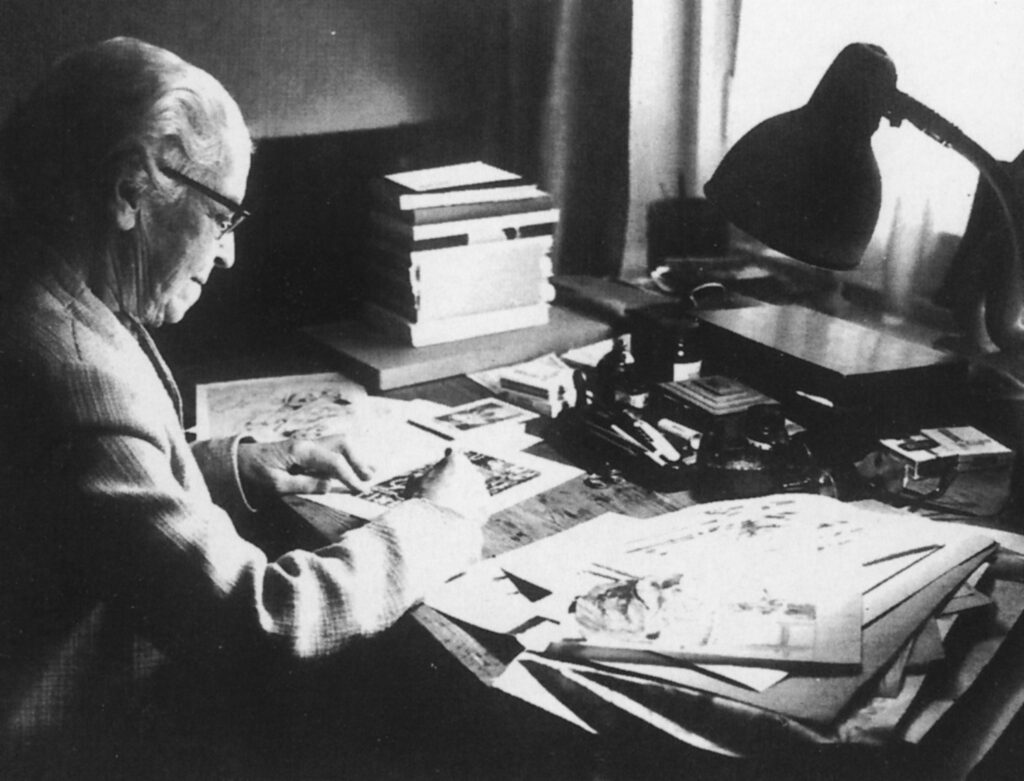
I remember Ham best sitting at her desk, wearing powerful binocular magnifying glasses, working late into the night on even the smallest details of her stamp designs.
Per Olov Jansson
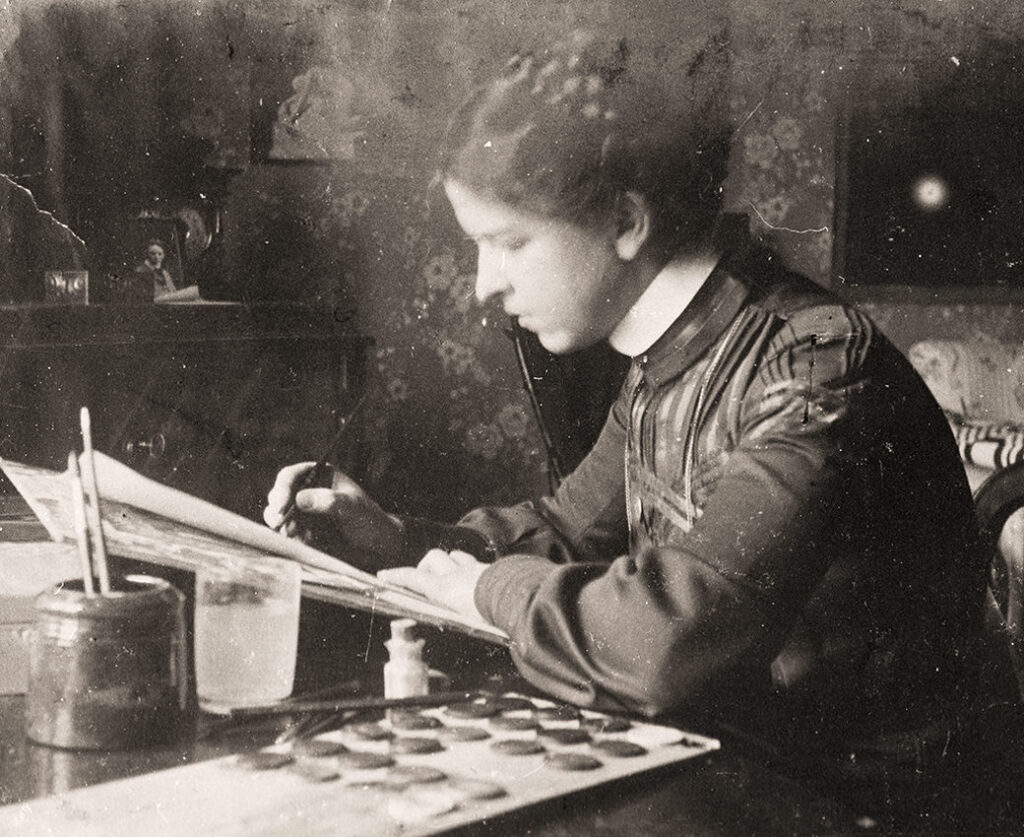
 Ham did much more than just housework; she provided for her family with her illustration work. Read more about balancing family and work.
A pioneer of Finnish stamp art
In 1924, at the age of 42, Ham began working part-time as a draftsman at the Bank of Finland’s Banknote Printing Works. Initially, she designed share certificates, bonds, address labels, and postage stamps. In the 1930s, several artists were responsible for designing Finnish postage stamps, but from the 1940s onwards, Ham became the most important designer of Finnish postage stamps. Her works were classic, with precise line drawings and clear visuals, but at the same time, they expressed artistic sensitivity and a deep understanding of the subject.
Ham’s stamps featured national and historical themes, such as Finnish buildings, landscapes, famous people, animals, and symbols. Her beloved Finnish archipelago and nature are reflected in many of the stamps she designed. She also designed numerous stamps for the Red Cross and for support of tuberculosis care, often with animals and plants playing a central part in the motifs.
Best-known stamps
Among the stamps designed by Signe Hammarsten Jansson are several classics, such as Turku 700 Years (1929), which was the first commemorative stamp to depict a cityscape, marking a significant departure from earlier heraldic themes. Mammals – Otter (1961) was Hammarsten Jansson’s skillful depiction of a wild animal in the tuberculosis series.
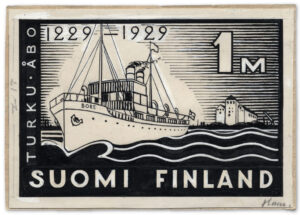 In 1929, three postage stamps designed by Signe Hammarsten Jansson were issued to commemorate the 700th anniversary of the city of Turku. These stamps were the first in Finland to feature an image other than the coat of arms lion. Photo: Postal Museum.
 The final Otter-stamp by Signe Hammarsten Jansson, 1962. Photo: Signe Hammarsten Jansson Estate
Around six billion of Signe Hammarsten Jansson’s stamps were printed, and she remains the artist who has designed the most stamps in Finnish history. Her work also influenced other visual fields, such as the design of banknotes and other official printed documents.
 In honor of the 1940 Helsinki Olympics, which were never held due to the war, the organizing committee launched a stamp design competition. Ham took part in the competition by submitting a series of sketches. Photo: Postal Museum
 Artistic legacy and influence
Ham was not only an artist, but also the intellectual and artistic centre of the family. Tove Jansson is said to have learned to draw on her mother’s lap even before she could walk. Ham’s disciplined and dedicated approach to art profoundly affected Tove and is reflected in her life’s work, whether it be in Moomins, painting, or literature.
 Little Tove Jansson in her mother’s arms in the mid-1910s.
The stamps designed by Signe Hammarsten Jansson are part of Finland’s visual history. They are not just collectors’ items, but cultural documents that combine art, history, and national identity on a small piece of paper. Her work lives on – literally in the billions – and continues to inspire new generations.
A sense of belonging and security in stamps
James Zambra, Creative Director of Moomin Characters, has designed the 2025 Moomin stamps for the Finnish postal service Posti. The series consists of six stamps borrowing illustrations from the Moomin comics. The pastel colours and theme are based on the look of the Moomin 80th anniversary in 2025. ‘The stamp illustrations reflect the anniversary themes: togetherness, time spent together, a sense of security, and space to be yourself,’ says Zambra, the grandson of Tove Jansson’s brother Lars.
 Creative Director of Moomin Characters, James Zambra
 Moomin stamps 2025
The new stamps combine the nostalgia beloved by collectors and the visual clarity familiar from the Ham era with a contemporary look and the Moomin philosophy. They are part of a continuum and a separate chapter in the history of Finnish postal art and Moomin collecting.
Check out the stamps designed by Signe Hammarsten Jansson in the Postal Museum’s online exhibition (in Finnish).
All published Moomin stamps can be found here.


