


Tove Jansson as a postcard artist – the visual language of Easter

Tove Jansson’s various illustration works constitute an interesting and often overlooked part of her extensive artistic output. In particular, her multifaceted Christmas and Easter cards offer a fascinating glimpse into her visual expression, which combines humor, sensitivity, and a Nordic atmosphere.
The visual world of Easter cards

Tove Jansson is best known for her Moomin stories, but her work extended to many other visual forms, such as magazine illustrations, cartoons, and, in particular, postcards. In the Easter cards she illustrated for Taidekorttkeskus (“The Central for Art Cards”) in 1942, she had not yet published the first Moomin story, but her talent for designing characters was already evident in the humans, kittens, and roosters she created for the cards. The illustrations reflect her recognizable style that was later on display in the Moomin illustrations: beautiful depictions of nature, rounded shapes, and expressive eyes.
Jansson’s illustrated Easter cards highlight the signs of spring: melting snow, the first flowers, and the brightening light. Typical motifs include roosters, rabbits, and witch-like figures, which allude to Finnish Easter traditions. These images often reveal subtle movement and vitality – the figures are not merely decorative, but possess personality and narrative depth. The mood of the Easter cards ranges from playful to melancholic. In Jansson’s illustrations, spring is not merely a joyful celebration, it is also associated with quiet anticipation and the fragility of nature’s awakening. This is evident, for example, in the empty landscapes where a single figure walks through melting snow, or in small details such as a flower reaching out cautiously.

Symbolically, Easter is associated with renewal and hope, and these themes are strongly present in Jansson’s work more broadly. Her Easter cards can be seen as part of this continuum: they depict change, transition, and new beginnings through very subtle visual means.
Artistic style and technique
Jansson’s smooth line is a central element of her art and of the charm of her postcards. She combined precise, controlled drawing with soft, watercolor-like coloring. In her Easter cards, the colors are often pastel: pale yellow, delicate green, and soft blue, which create a spring-like and light impression.

Cultural significance

Jansson’s postcards, including those with Easter themes, were part of a broader culture of visual communication at a time when postcards were a primary means of sending greetings. At the same time, they also served a very practical purpose in the artist’s life.
As early as the beginning of the 1940s, Jansson was painting dozens of postcards in watercolor at a rapid pace for various purposes, and creating these cards provided her with an important source of income during many stages of her life.
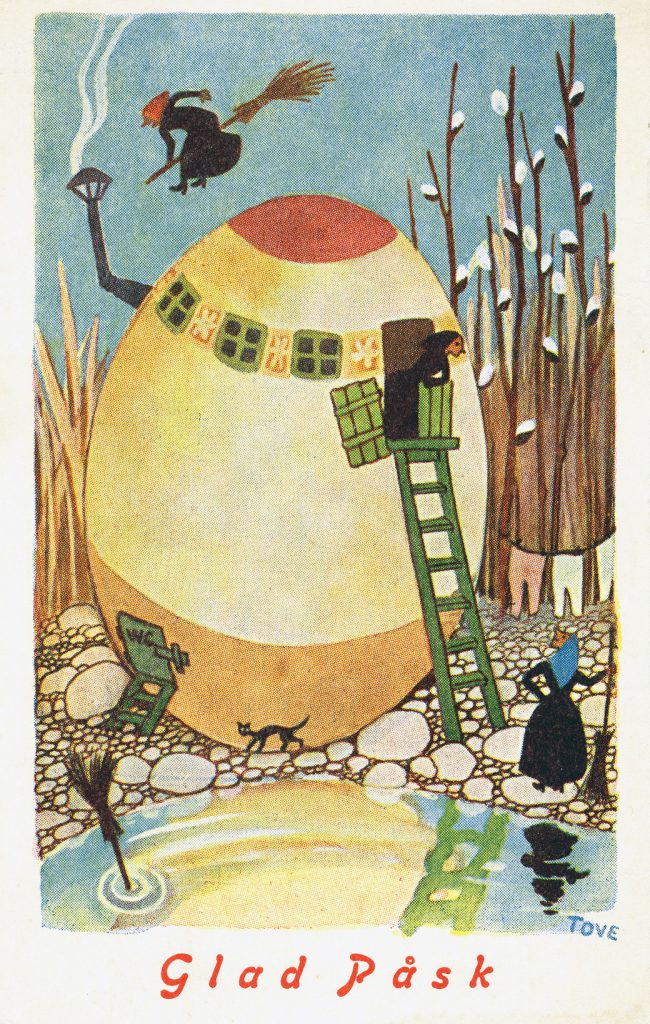
Compared to many other types of work, postcards were relatively quick to produce and easy to sell. For the artist, they were a tangible way to earn money; small, easily exchangeable works that combined art with everyday needs.
In 1942, Jansson’s cards were published by Taidekorttikeskus, a company that specialized in publishing art cards. That same year, she created Christmas cards, a humorous series of animal cards, and Easter cards featuring animals dressed in human clothing – a theme that perfectly suited her gently ironic and observant style. Read more about the Christmas card series here.
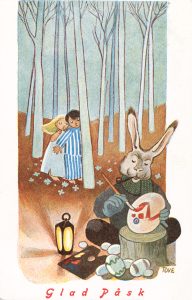
Today, these cards are collector’s items and offer an interesting addition to research on Jansson. They reveal the artist’s ability to adapt her expression to different formats while still maintaining her own recognizable style.
Did Tove Jansson ever make Easter postcards featuring Moomin characters? Of course she did!


