


Tove Jansson’s Midsummer illustrations on the cover of the satirical magazine Garm

Tove Jansson is known around the world as the creator of the Moomins, but her artistic sensibility began to take shape in a small, sharp-tongued editorial office: the Swedish-language satirical magazine Garm, for which she drew illustrations for over twenty years. Alongside political cartoons, Tove also illustrated cover images for the magazine that reflected the rhythm of the seasons and the holidays. Midsummer, the highlight of the Finnish summer, was a theme she returned to time and again.
Garm – a battleground and a nurturing ground for illustrators
Founded in 1923 by Henry Rein, Garm established itself as a satirical magazine with a focus on literature and culture, but it was also highly outspoken on political issues. The magazine described its own stance as “democratic-conservative,” and over the years, it took aim at extremist movements on both the right and the left.
Tove Jansson began her career at Garm at the age of 15 in 1929, following in the footsteps of her mother, Signe “Ham” Hammarsten Jansson. Ham had worked at the magazine since its founding, and Tove, in turn, worked for the magazine until its closure in 1953. During that period, spanning nearly a quarter of a century, she drew about a hundred cover illustrations and approximately 500 other illustrations for the magazine.
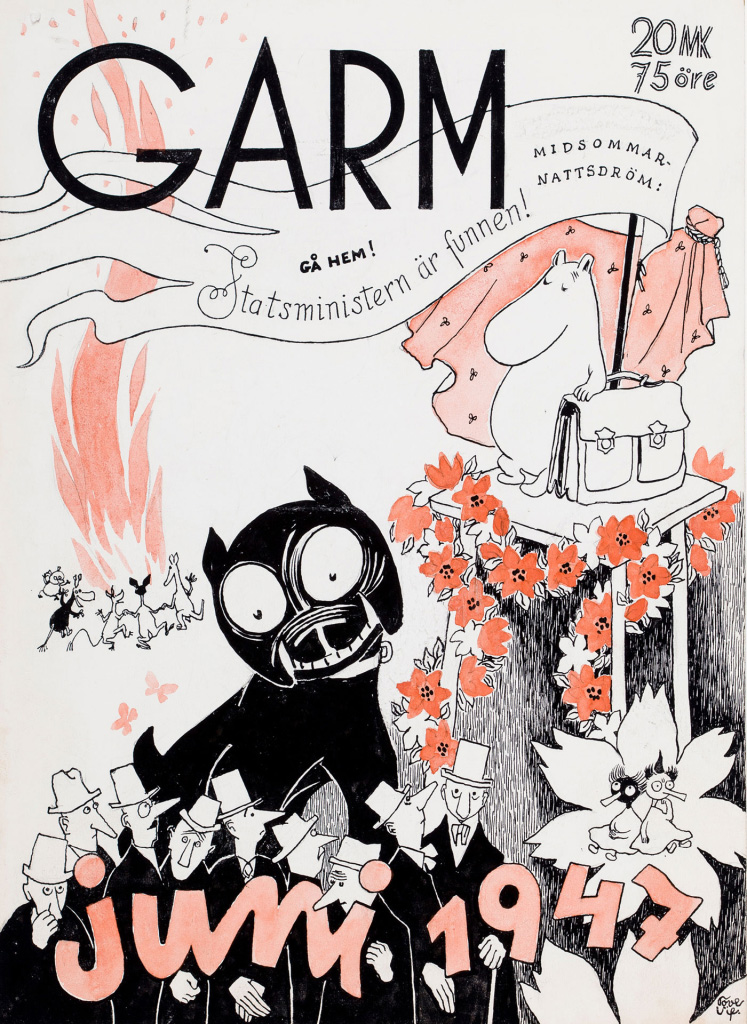
 The Midsummer edition cover for Garm, June 1947
In her cover illustrations, Tove depicted everything from the life of an artist to the events of the war years. During World War II, she became the magazine’s leading illustrator, using her own name to criticize, among others, the leaders of enemy nations.
Midsummer – a symbol of joy and peace in the shadow of war
 The Midsummer edition cover for Garm, June 1941
In the monthly publishing rhythm of the Garm magazine, the summer issues were something special. The colourful cover images centered around Midsummer gave the magazine a playful, scenic tone, often strongly influenced by a Finnish connection to nature. Tove, who grew up in an artistic family and spent her childhood summers on the shores of the Baltic Sea both in Finland and Sweden, was familiar with the bright summer nights and Midsummer traditions.
During Finland’s war years, 1939–1944, the significance of Midsummer magazine covers changed. As World War II raged across Europe and Finland lived under the exceptional conditions of the Continuation War, a summer landscape was not merely a decorative element but a reminder of what everyday life in peacetime might look like. Garm’s satirical drawings and cover illustrations were known for their openly anti-fascist stance and bold take on current events, and the Midsummer covers represented the lighter side of this overall theme.
 The Midsummer edition cover for Garm, June 1940
 The cover illustration from the summer of 1943 shows that Tove Jansson had plenty of experience with the tradition of taking a ferry from the mainland to the archipelago in early June. The ferries were packed to the brim, and passengers lugged along everything they thought they would need for their summer vacation. Nevertheless, the mood was generally high, despite the war years.
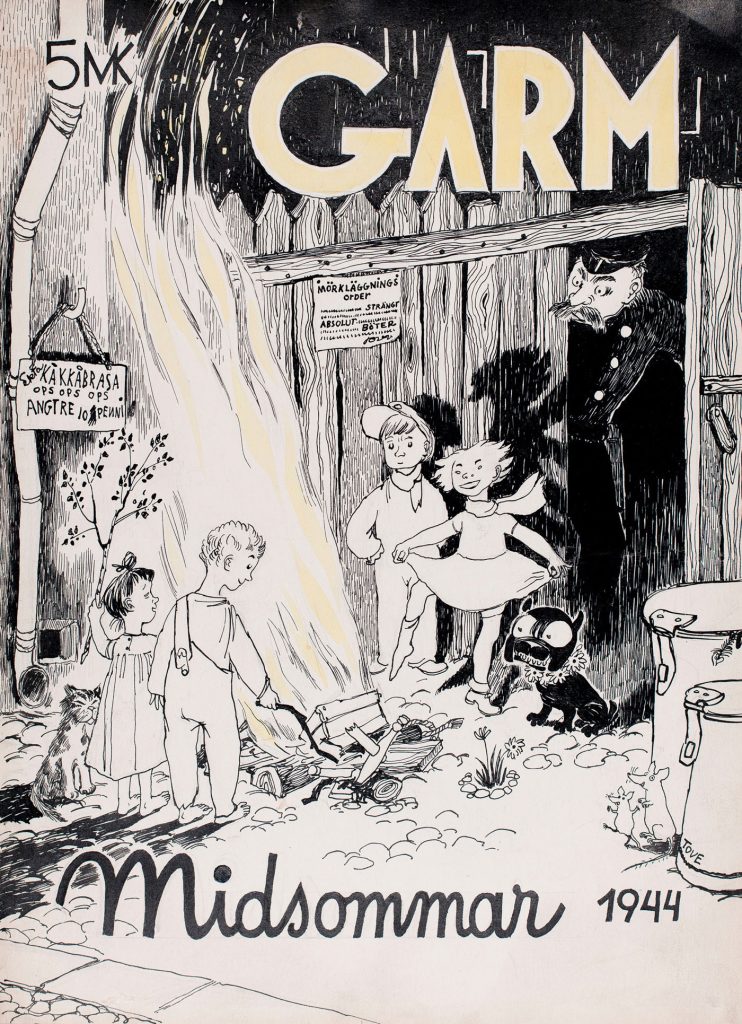 On the cover of the 1944 Midsummer issue, children are selling tickets to watch their Midsummer bonfire. In the background, a sign reminds readers of the blackout regulations, as lights had to be kept off during the war.
The imagery of Midsummer: nature and the bright night
Tove Jansson’s Midsummer cover illustrations feature recurring, recognizable elements: the silhouettes of white birch trees, figures dancing in the twilight of a summer night, the flames of the Midsummer bonfire, and the wild archipelago landscape. People are dancing or sitting in a meadow; the landscape is open and atmospheric.
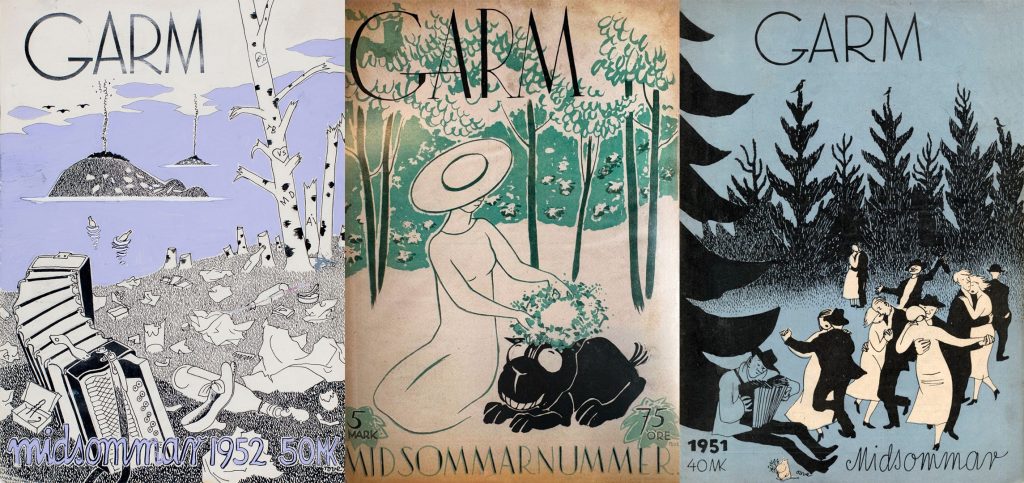 In the same issue that might feature a woman in summer attire on the cover, standing at the edge of a birch grove, the inside pages might contain a sharp-tongued political caricature. Tove mastered both styles with great skill and successfully balanced these topical themes so that they worked together.
The ancestor of the Moomin character
 Tove Jansson’s Snork character on the cover of Garm in August 1945, a few months before the first Moomin story was published.
Moomintroll also made its public debut in the pages of Garm. The character, whom Tove still called “Snork” at the time, served as the trademark of her drawings and, along with her signature, as her personal emblem. The cover illustrations from Tove Jansson’s years at Garm can also be seen as a kind of artistic incubator: in the pages of the magazine, she may have experimented with moods, visual storytelling, and characters that later matured into stories in the Moomin books.
Legacy
Jansson’s political caricatures in Garm attracted attention when she boldly mocked both Hitler and Stalin on magazine covers under her own name during World War II. But her legacy in Garm extends beyond mere political courage. It is also a legacy of artistic diversity: the ability to move seamlessly between war-time satire and the tenderness of the Midsummer night.
Tove Jansson’s Midsummer cover illustrations remind us that an artist also needs room for joy, and that a summer scene rendered with the lightest of strokes can convey just as much truth as even the sharpest political satire.


